
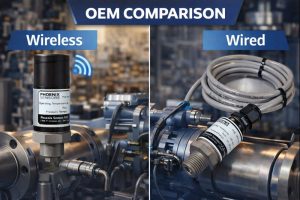
Choosing between wireless and wired pressure sensors is a common decision point for OEM engineers designing new equipment or refining existing systems. Each approach has strengths and limitations that affect installation, reliability, maintenance, and long-term cost. This article breaks down wireless vs wired pressure sensors using practical, engineering-focused criteria to help you determine which option best fits your application.
Defining Wireless and Wired Pressure Sensors
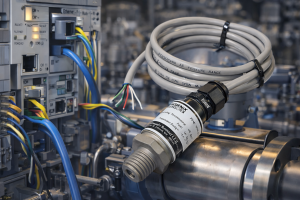
Wired pressure sensors transmit pressure data through a physical electrical connection. Common outputs include analog signals such as 4-20 mA or 0-5 V, as well as digital protocols like RS485, CAN, or I2C.
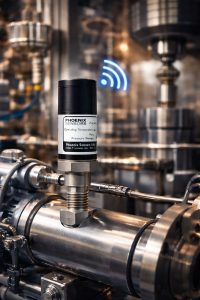
Wireless pressure sensors transmit data via RF communication, often using Bluetooth Low Energy or proprietary industrial wireless protocols. These sensors are typically battery powered and communicate through a gateway or receiver.
Both technologies are widely used in OEM designs, but they solve different problems.
Installation and System Integration
Wired Pressure Sensors
- Require cabling, connectors, and proper strain relief
- Long cable runs increase installation time and routing complexity
- Simple and predictable integration with PLCs, ECUs, and control systems
Wireless Pressure Sensors
- Minimal wiring, often limited to mechanical mounting
- Faster installation in rotating, mobile, or hard-to-access assemblies
- Requires pairing, network configuration, and signal validation
From an OEM standpoint, wired sensors are easier to standardize for production builds, while wireless sensors can simplify installation in niche or retrofit applications.
Cost Considerations Over the Product Lifecycle
Evaluating wireless vs wired pressure sensors requires looking beyond unit price and considering total cost of ownership.
- Wired sensors generally have a lower unit cost but higher installation labor due to wiring.
- Wireless sensors often have a higher unit cost and may require gateways, but reduce wiring labor.
In high-volume OEM programs, wired sensors often deliver lower overall system cost. Wireless solutions tend to make sense in lower-volume systems, pilot programs, or applications where wiring costs dominate.
Reliability and Data Integrity
Wired Sensors
- Deterministic signal transmission
- Unaffected by RF interference
- Well suited for closed-loop control and safety-critical systems
Wireless Sensors
- Performance depends on signal strength and RF environment
- Potential for packet loss or latency
- Typically used for monitoring rather than real-time control
For applications where continuous data and system uptime are critical, wired sensors remain the preferred choice. Phoenix Sensors regularly supports OEMs in these environments by designing robust wired pressure sensors tailored for harsh conditions.
Maintenance and Long-Term Support
Maintenance requirements differ significantly when comparing wireless vs wired pressure sensors.
- Wired sensors usually require little to no maintenance once installed.
- Wireless sensors introduce battery life as a maintenance variable.
In applications with limited physical access, battery replacement schedules should be carefully evaluated during the design phase.
Ideal OEM Applications
Wired Pressure Sensors Are Best For:
- Fixed industrial equipment
- High-pressure or high-temperature systems
- Closed-loop control and safety-related functions
Wireless Pressure Sensors Are Best For:
- Rotating or mobile equipment
- Temporary testing and diagnostics
- Applications where wiring is impractical
Conclusion: Selecting the Right Sensor for Your Design
There is no one-size-fits-all answer to the question of wireless vs wired pressure sensors. Wired sensors continue to dominate in production OEM systems that demand reliability, precision, and long-term stability. Wireless sensors provide flexibility where installation constraints outweigh concerns around power and connectivity.
OEM engineers benefit most by defining performance, maintenance, and lifecycle requirements early. With experience supporting both wireless and wired designs across diverse industries, Phoenix Sensors works with OEMs to evaluate tradeoffs and identify pressure sensing solutions that align with real-world application demands.
Need help deciding what sensor is best for your application? Contact us today!