
Selecting pressure sensors for critical applications depends on accuracy, which drives reliability and cost. Accuracy is not a single number; it aggregates multiple error sources across the operating range.
Accuracy defines closeness to true pressure; precision defines consistency. A device can be precise but inaccurate, or accurate but imprecise—both matter.
What Is Pressure Sensor Accuracy?
Accuracy reflects combined effects of multiple errors defined by standards like IEC 61298-2. Specifications should clearly state the components and methods used.
Confusion often comes from treating accuracy as a single test result; it is the aggregate behavior across range and life.
The Building Blocks of Pressure Sensor Accuracy
Linearity
Indicates deviation from an ideal straight-line response, typically as %FSO. Smaller is better across the usable span.
- End Point Method (EPM): line through first/last points.
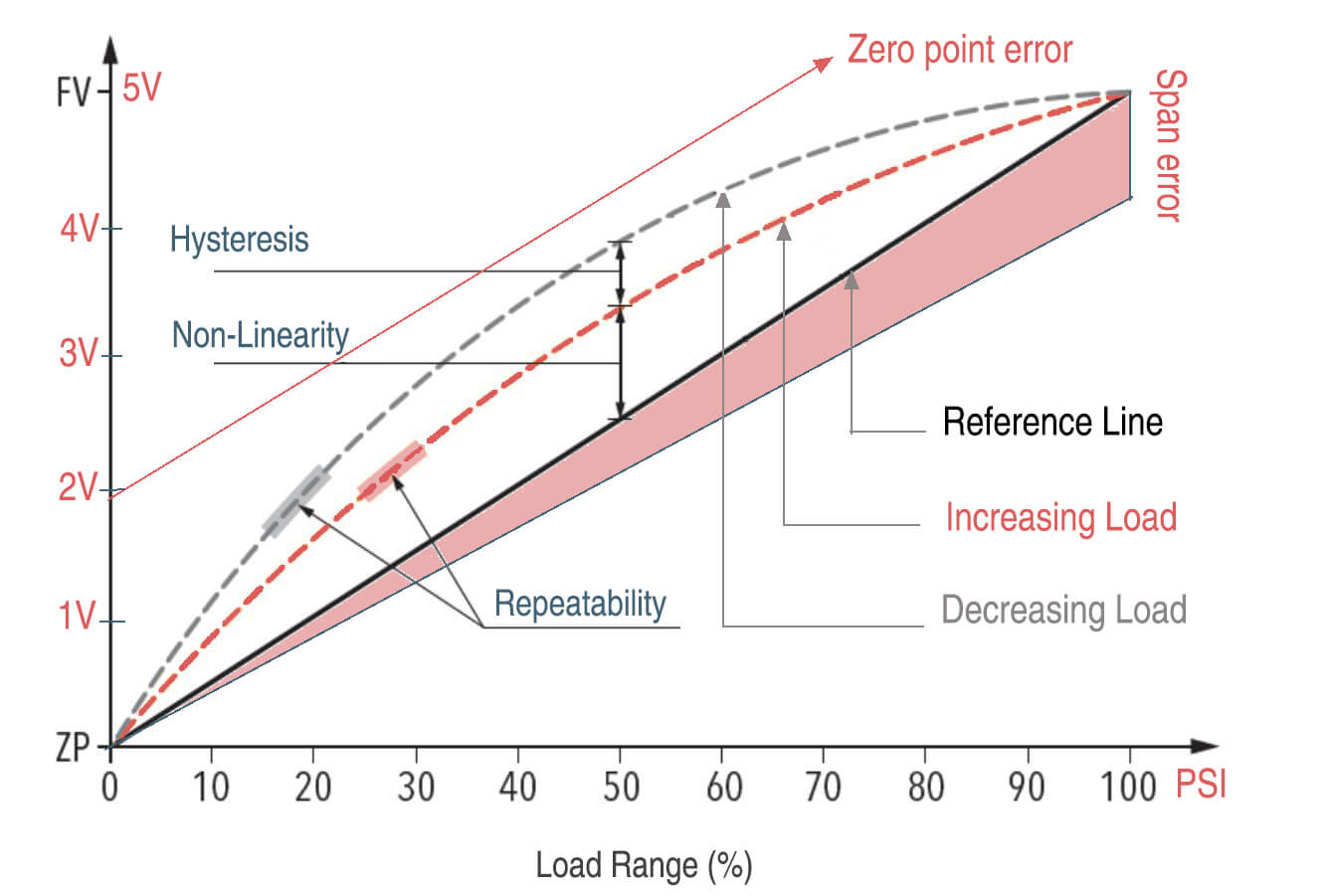
- Best Fit Straight Line (BFSL): line minimizes max deviation.
Hysteresis
Difference in output at the same pressure during rising vs. falling cycles. Driven by mechanical properties and internal friction; critical in cyclic applications.
Hard to compensate because it depends on recent pressure history, not just the current value.
Repeatability
Consistency of readings at identical conditions; indicates sensor stability and noise. Poor repeatability suggests construction or electronics issues and is not easily corrected by calibration.
High repeatability supports process control and long-term stability.
Understanding Total Error Band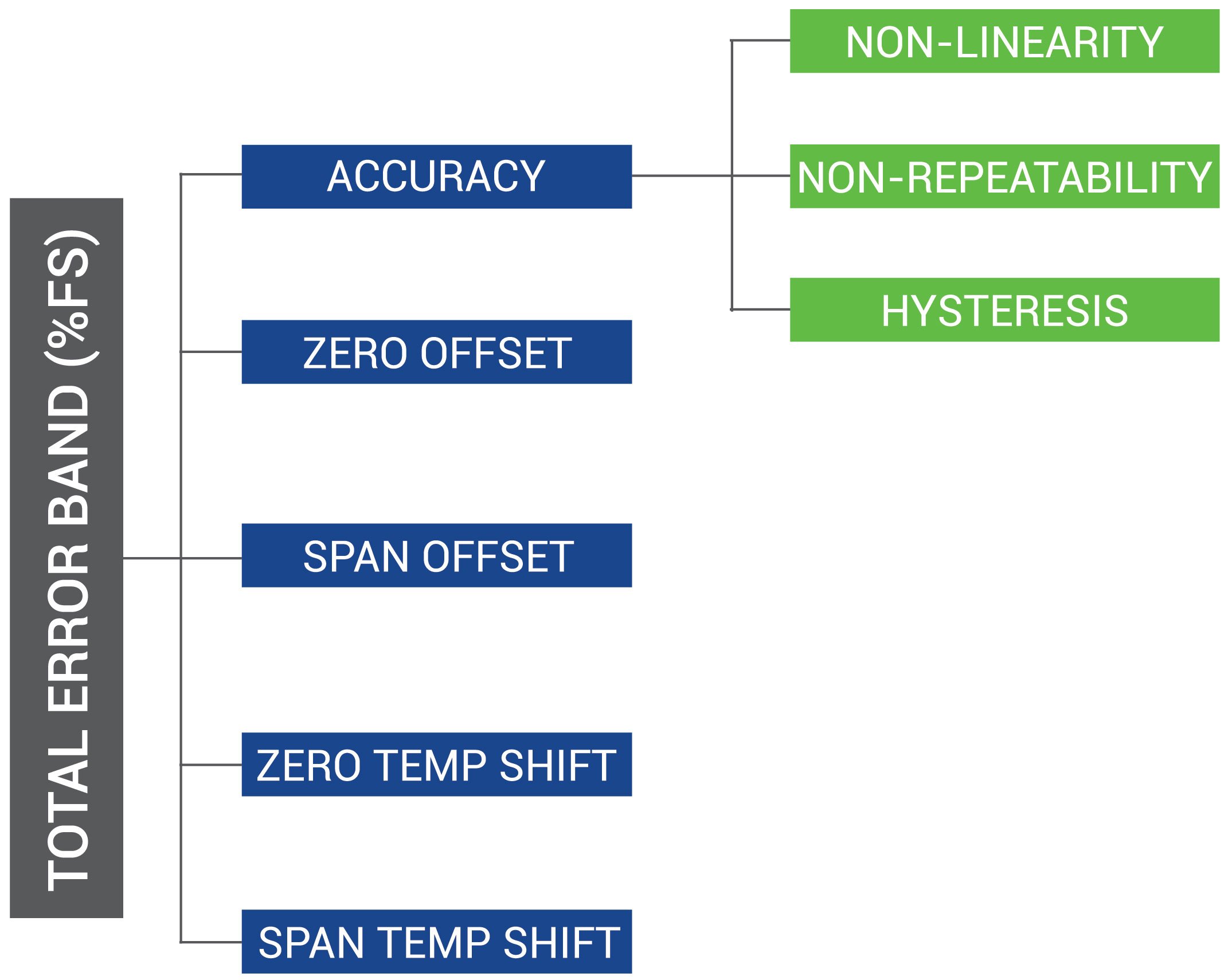
TEB is the RSS of non-linearity, hysteresis, and non-repeatability; over the compensated range it often includes thermal zero/span effects.
Example (room-temp NLH/R): 0.25% NL, 0.15% Hys, 0.10% NR → TEB_RSS ≈ sqrt(0.25² + 0.15² + 0.10²) ≈ 0.31% (vs. 0.50% sum).
Common Misconceptions About Pressure Sensor Accuracy
- Accuracy is uniform across the entire range: it often varies with level and temperature.
- Resolution equals accuracy: high display resolution can mask lower accuracy.
- Room-temp specs predict field results: temperature coefficients and environment matter.
Evaluating Accuracy Specifications in Practice
- Confirm which components are included (linearity, hysteresis, repeatability) and the calculation method (e.g., BFSL vs. EPM, RSS).
- Compare like-for-like headline numbers; methods can shift specs meaningfully.
- Match component errors to application needs; e.g., repeatability for control loops.
Real-World Factors Affecting Accuracy

Lab specs are baselines; installation and environment dominate field performance.
- Mounting stress can bias strain-based sensors.
- Pressure pulsation, vibration, and EMI add noise and error.
- Temperature cycling can shift zero/span; review coefficients.
The Phoenix Sensors Approach to Accuracy
Design focuses on minimizing error sources through sensing element selection, materials, and processes—not just post-calibration. Specifications follow industry-standard methods for transparent comparisons.
Custom OEM experience informs accuracy targets across diverse use cases and environments.
Making the Right Choice for Your Application

Look beyond a single accuracy number; review components, methods, and conditions. Sometimes stability and repeatability outperform aggressive lab specs in real-world duty.
Align sensor characteristics to operating range, thermal profile, and dynamics to minimize total system error.
For inquiries or specifications support, Please Contact Us!