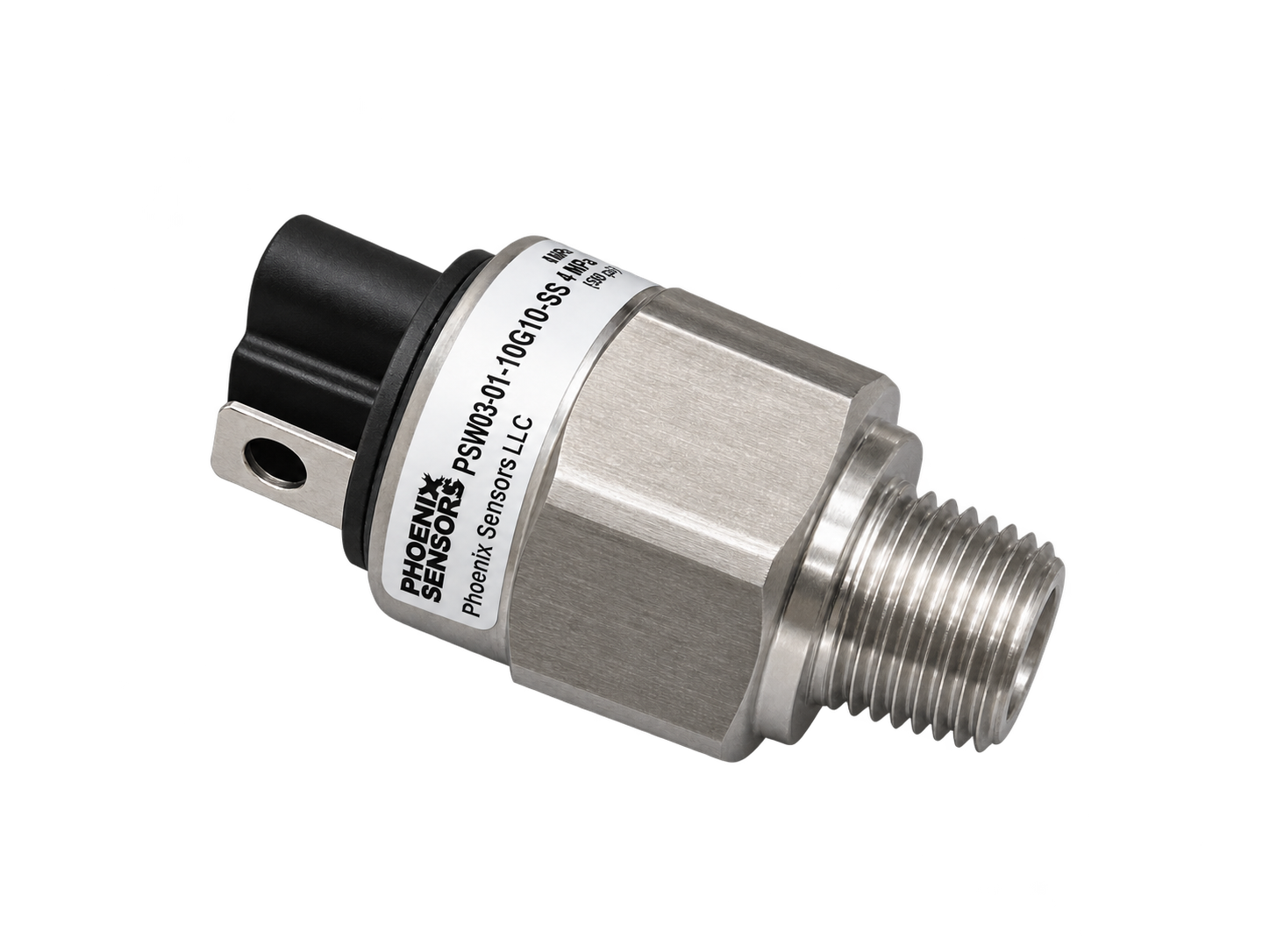
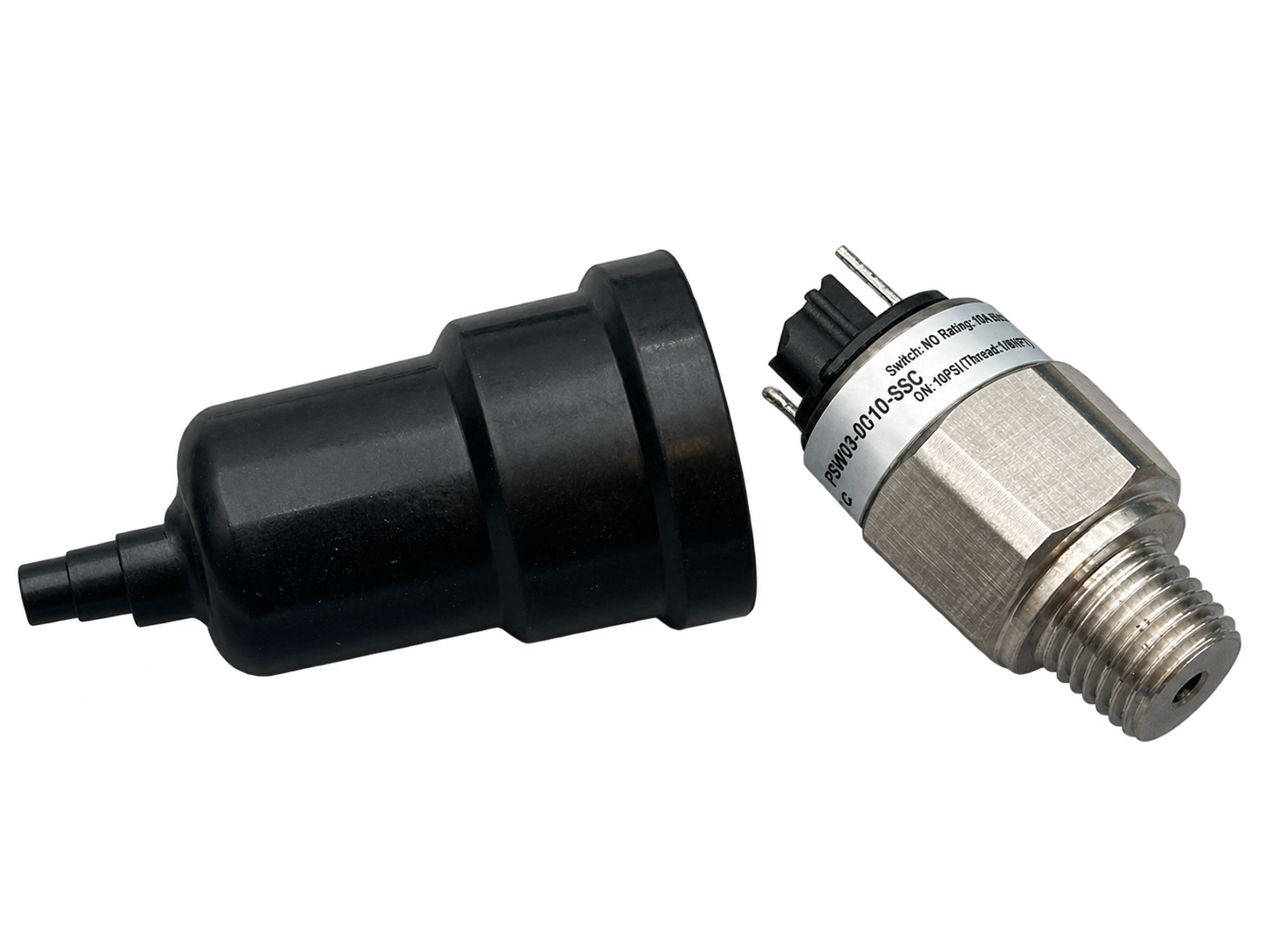
The PSW03 stainless steel pressure switch turns your circuit on or off at a set pressure, with no signal conditioning required. We set the switch point at our facility to match your requirement, so the switch arrives ready to install.
The PSW03 pairs a compact 316L stainless steel housing with a standard NPT port and spade terminals. Four pressure ranges cover switch points from 5 to 300 psi. Download the datasheet for full specifications and dimensions.
Why OEMs choose the PSW03 stainless steel pressure switch
Many OEM systems do not need a continuous pressure reading. They need a dependable yes-or-no answer. Is there enough pressure to run? Is there too much to continue? A pressure switch answers that question directly and keeps your control design simple.
The PSW03 gives you that answer in a rugged, compact package. Its stainless steel body is built for water service. Its switch point is matched to your application before it ships. Your team installs it and moves on. There is no calibration step on your production line.
Key features of the PSW03
Factory-set switch point: Set to your required pressure within the range you select
Four pressure ranges: 5–25, 20–60, 50–150, and 150–300 psi
Your choice of contact: Normally open or normally closed
Rugged housing: 316L stainless steel standard, with steel and brass options
Standard ports: 1/4″ NPT or 1/8″ NPT male thread
Quick wiring: 0.25″ spade terminals, with an optional protective cover
Wide temperature range: Operates from -20°C to +90°C
Stainless steel pressure switch applications
A stainless steel pressure switch like the PSW03 suits OEM equipment that must confirm pressure before it acts, including:
HVAC chillers and hydronic heating systems
Expansion tank pressure monitoring
Pumps and water circulation systems
Commercial food service equipment
Spa and pool equipment
Water treatment and filtration systems
Designing chillers or other refrigeration equipment? ASHRAE’s refrigeration resources cover standards and engineering practices for these systems.
Set to your switch point, built to hold it
Every PSW03 is an adjustable pressure switch. A screw on top of the switch moves the point where the contacts change state. We use it to set your switch point, then confirm the setting by cycling pressure on and off.
Once the setting is verified, we lock the adjustment screw in place. In our testing, a locked switch held its switch point with no observed drift. You get a part that performs the same in the field as it did on our bench.
Keep in mind that adjustment moves the switch point, not the switching band. Every mechanical pressure switch has some hysteresis between where it closes and where it reopens. The datasheet lists the tolerance for each range.
Choosing the right Phoenix Sensors pressure switch
We offer more than one switch for water systems. The PSW01 Adjustable Water Pressure Switch is another option for water pressure control. Compare the two datasheets, or ask our engineers which one fits your design. We are glad to review your pressure, media, and wiring needs.
If your controller needs a continuous pressure signal rather than an on/off contact, a transducer is the better choice. Consider the PPT82 Microfused HVAC Pressure Transducer Analog Output for HVAC systems. Choose the PSW03 when a simple, factory-set switch point is all your system needs.
PSW03 frequently asked questions
What pressure ranges does the PSW03 cover?
The PSW03 is available in four ranges: 5–25, 20–60, 50–150, and 150–300 psi. We set the switch point to your requirement within the range you choose.
Is the PSW03 normally open or normally closed?
Both versions are available. A normally open switch closes when pressure reaches the switch point. A normally closed switch opens at the switch point.
Can the PSW03 be customized?
Yes. Switch point, pressure range, contact type, port thread, housing material, and cover are all configurable for OEM production programs.
Configure the PSW03 stainless steel pressure switch for your OEM application
We support OEM customers from first samples through full production. Need a different range, thread, or connection? Learn more about our custom sensor capabilities, or talk to an engineer today.