
An obsolete pressure transducer replacement usually starts with bad news from purchasing. The supplier has discontinued the part, or lead times now run past what your build schedule can absorb. The quick fix is to find a sensor with the same pressure range and thread, order samples, and move on.
That shortcut works often enough to be tempting and fails often enough to be expensive. Swap a gauge sensor for an absolute one, and the reading shifts by about 14.7 psi at sea level. A different zero offset can push a process out of tolerance weeks later. This guide covers what has to match when you replace an obsolete pressure transducer, what can be adapted, and what only testing will confirm.
Key takeaways for OEM engineers
- Matching range, output, and thread makes a candidate, not an equivalent.
- Sort every parameter into must match, may adapt, or requires testing.
- Gather legacy data, samples, and real operating conditions before you search for a legacy pressure transducer replacement.
- Plan for qualification from day one. Fit and form can be checked on paper; function cannot.
In this guide: Why range is not enough | Gather the data | Parameters to compare | Sort the parameters | Qualification | Checklist | Supplier questions | FAQ
Why range and thread are not enough
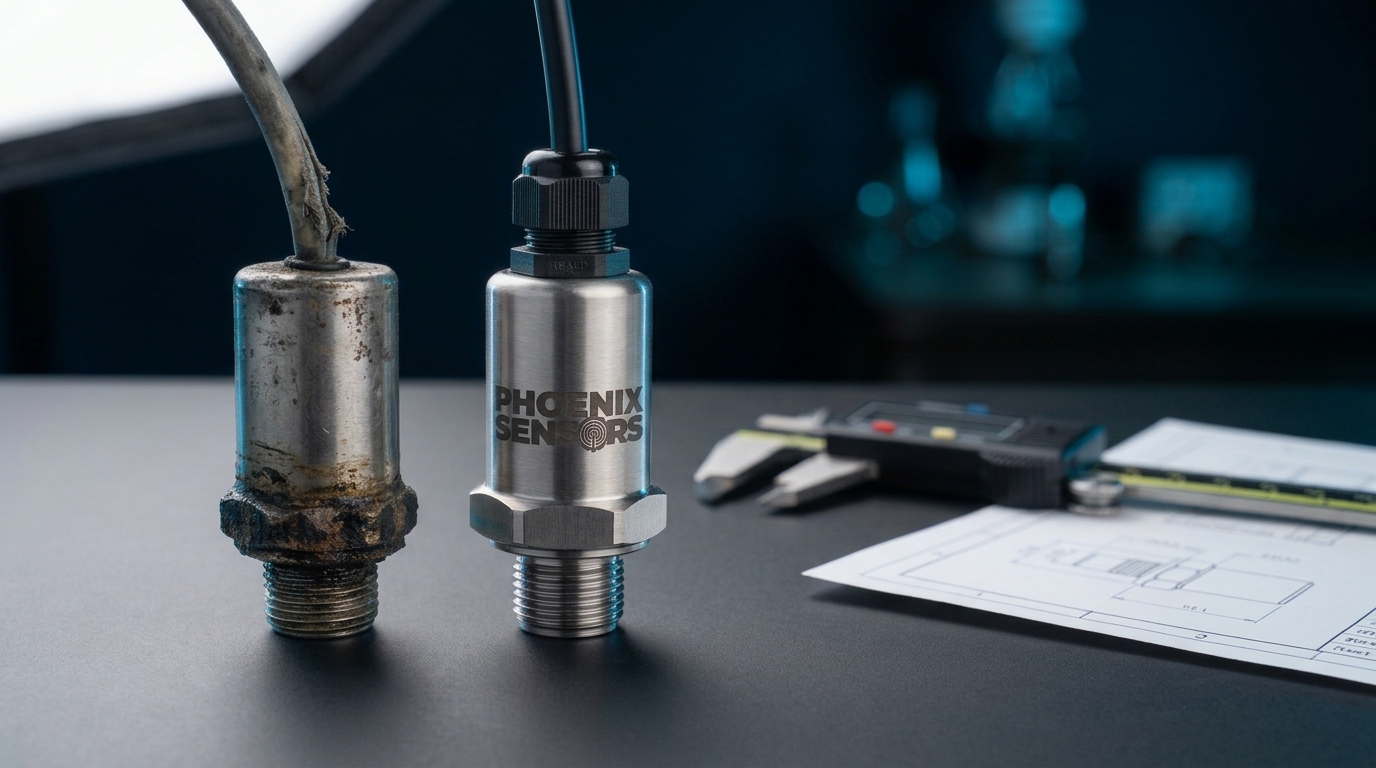
Range and thread are the most visible specs on a discontinued pressure transducer, so they dominate the first search. But a transducer sits inside a system that depends on many other characteristics. Most of them stay invisible until something misbehaves.
The failures are rarely dramatic:
- A slightly different transfer function reads a few percent off. Nobody notices until a process drifts out of tolerance.
- A different response time changes how a control loop behaves.
- A different fault-state output means a broken wire no longer triggers the alarm it used to.
These problems surface in production, not on the bench. It is the same gap that explains why pressure sensors can fail after passing bench testing.
Replacement is not the same as second sourcing
A second source is qualified while the original part is still available. You can test the two side by side and compare results. With a discontinued pressure transducer, the original may be all you have left. That changes how you gather data and how much testing you need.
Start an obsolete pressure transducer replacement with the right data
Incomplete information is the most common reason a replacement effort stalls or lands on the wrong part. Gather these items before you search:
- The legacy datasheet, even a partial or scanned copy
- The original part number, including any revision suffix
- Assembly and installation drawings showing how the part mounts and connects
- Physical samples, ideally both used and unused
- Actual operating conditions: pressure, temperature, media, and vibration
- Measured or estimated transient pressures
- The wiring diagram and controller input configuration
- Any scaling or calibration constants in the control system
- Annual quantity and forecast
- The approval process and timeline your organization or customer requires
- Known failure history of the original, which often explains its specification choices
When documentation is missing
A physical sample of the discontinued pressure transducer is worth a great deal when records are gone. That is common for a part that has been in production for fifteen years. Dimensions, thread, pinout, and often materials can be established from the part itself.
Measurement characteristics can be recovered by testing a working unit against a calibrated pressure reference. In the U.S., pressure calibrations typically trace back to standards maintained by the NIST pressure and vacuum metrology program.
Put your effort into documenting the real application conditions. You need a sensor that works in your system, not a perfect copy of a part nobody has records for.
Parameters to compare on every candidate
Check each candidate against the original part itself, not just against its old datasheet. The parameters fall into three groups.
Measurement characteristics
- Pressure range and reference type. Gauge, sealed gauge, absolute, or differential. A gauge and an absolute sensor with the same nominal range are not interchangeable. The swap creates a constant offset of about one atmosphere that is easy to misdiagnose.
- Accuracy. Compare like for like. Identical accuracy numbers on two datasheets often describe different things, as we explain in understanding pressure sensor accuracy.
- Response time. This matters wherever the transducer feeds a control loop. A slower part can destabilize tuning that was set for the original.
- Temperature range. Check both the operating and compensated ranges. A narrower compensated band shows more error at the extremes, even when the operating range looks fine.
- Proof and burst pressure. If the original survived your transients, a part with less margin may not.
Electrical characteristics
- Output signal and transfer function. Match the exact relationship between pressure and output, including zero offset. Two 0.5 to 4.5 V sensors can map that span to pressure differently.
- Supply voltage and ratiometric behavior. Check the range and tolerance. Swapping a ratiometric part for a regulated one, or the reverse, adds error that tracks supply variation.
- Pinout. Verify it against the drawing, never against a similar-looking connector. Pin assignments differ between manufacturers that use the same connector shell.
- Current consumption. This matters when several sensors share a supply or the system runs on batteries.
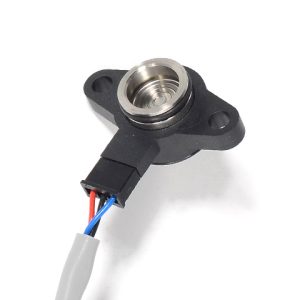
PPT71: built for ratiometric legacy outputs
Matching a legacy ratiometric output is easier when the transfer function is published. The PPT71 Small Analog High Accuracy Low Pressure Transducer gives a 0.5 to 4.5 V output that is ratiometric to its 2.8 to 5.5 V supply. Standard sealed gauge ranges are 10, 30, 50, and 100 PSI, with custom ranges and port configurations available. Its 0.55 inch low-profile body seals with an O-ring and mounts with a two-hole flange.
Mechanical and material characteristics
- Process connection. Verify thread type, size, and sealing method dimensionally, not by callout alone. Visually similar threads can mislead.
- Wetted and seal materials. The original seal material may have been chosen for your media years ago. Check the full wetted list, not just the housing alloy.
- Dimensions. Check the overall envelope, hex size, cable exit direction, and connector height. A part that works perfectly but does not fit the enclosure is still a failure.
- Connector or cable. Confirm the configuration, the length, and the mating half.
Must match, may adapt, requires testing
Sorting each parameter early tells you how much work the obsolete pressure transducer replacement really represents.
| Must match | May be adaptable | Requires testing |
|---|---|---|
| Reference type (gauge, absolute, differential) | Cable length | Long-term stability in your conditions |
| Output signal type | Connector, with a mating change | Media compatibility over service life |
| Transfer function, or system rescaling | Thread, with a verified adapter | Survival of your actual transients |
| Supply voltage compatibility | Housing dimensions, with bracket changes | Vibration and thermal cycling durability |
| Pressure range adequacy | Response time, if the loop is retuned | Control loop behavior in production |
| Regulatory approvals | Accuracy, if the application has margin | Field reliability versus the original |
Nothing in the third column can be resolved from a datasheet. Fit and form can be checked on paper. Function in your application is established by testing.
Adapting instead of matching
The middle column is where a configurable or custom sensor earns its place. A connector change, a new cable length, or a thread adapter is often simpler than chasing an exact legacy match. Each adaptation still needs a matching change on your side, such as a new mating connector or an updated bracket.
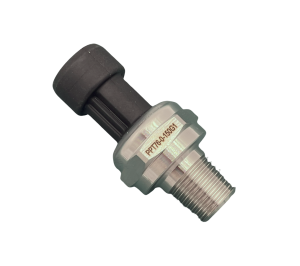
PPT76: one platform, three reference types
Reference type is a must-match parameter, so it helps when one platform offers all three. The PPT76 Water, Air, Oil Pressure Sensor, Analog Output, Stainless Steel, Quick Disconnect is available as absolute, gauge, or sealed gauge, selected by part number. Where the thread may be adapted, standard 1/4 inch NPT, 1/8 inch NPT, and 7/16-20 UNF ports are offered, plus custom ports. Ranges run from 30 to 3,000 PSI with a 0.5 to 4.5 V output, in an IP67-rated SS316L housing.
Qualifying the replacement before production
Qualification is usually where the schedule goes on an obsolete pressure transducer replacement. Plan for it from the first day rather than treating it as a final formality.
- Software and firmware. Scaling constants, calibration coefficients, and diagnostic thresholds may live in your control system. A new transfer function means those values change too, and someone has to find where they are stored.
- Calibration. Confirm how the original was calibrated and whether your process depends on those conditions.
- Regulatory requirements. Agency approvals and material certifications carried by the original may not carry over.
- Qualification testing. Run whatever your organization or customer requires before a changed component reaches production.
- Sample approval and first article inspection. Formally verify that delivered parts match what was agreed.
Treat obsolescence as a process
One discontinued pressure transducer is often a warning that other parts will follow. IEC 62402 gives requirements and guidance for managing obsolescence across the product life cycle. Recording why each sensor was specified makes the next obsolete pressure transducer replacement much faster.
Obsolete pressure transducer replacement checklist
Use these questions in design review before you approve a legacy pressure transducer replacement.
- Does the reference type match: gauge, sealed gauge, absolute, or differential?
- Is the transfer function identical, including zero offset, or will the controller be rescaled?
- Is the supply voltage compatible, and does the ratiometric behavior match?
- Has the pinout been verified against the drawing?
- Do the compensated temperature range and accuracy meet the application?
- Do the proof and burst ratings cover your measured transients?
- Are all wetted and seal materials compatible with the media?
- Does the part fit the envelope, including hex clearance and cable exit?
- Do the original approvals and certifications carry over?
- Has every scaling constant in the control system been located?
- Is there a qualification plan, with time for it in the schedule?
If any answer is no or unknown, the part is still a candidate, not yet a legacy pressure transducer replacement.
Questions to ask a supplier about a discontinued pressure transducer
A supplier’s answers show whether they are matching a part number or solving your problem.
- What legacy data do you need from me to evaluate a match?
- Can you characterize a sample of the original if no datasheet exists?
- Which parameters can you match exactly, and which would need an adaptation?
- Can the output, process connection, or connector be configured to suit the legacy installation?
- What validation data can you provide, and under what test conditions?
- How do you handle sample approval and first article inspection?
- How do you manage component obsolescence on the replacement itself?
Have a legacy part to replace?
If you have drawings, samples, or even a partial datasheet, we can review the application with you before you commit to a candidate.
FAQ: obsolete pressure transducer replacement
Those three make it a plausible candidate, not a confirmed equivalent. Reference type, transfer function, compensated temperature range, wetted materials, proof pressure, and pinout still need verification. Any one of them can produce a part that works on the bench and misbehaves in service.
A physical sample of the discontinued pressure transducer carries most of what you need. Dimensions, thread, pinout, and often materials can be measured from the part. Measurement characteristics can be recovered by testing a working unit against a calibrated reference.
Dimensional and electrical equivalence can be checked against documentation. Functional equivalence in your application cannot be guaranteed without review and validation. Treat a promised drop-in as a starting point for qualification, not a substitute for it.
It depends on where the cost sits. Matching the original avoids software changes and control system requalification. Rescaling can open up more sensor options, but every place the old constants live must be found and updated.
A second source is qualified while the original is still available, so the two can be compared directly. With an obsolete part, the original may be gone. Samples, drawings, and field history then carry more weight.
Send us the legacy part details
Obsolescence work is a regular part of what our engineering services team handles, including redesign around discontinued components. Send us what you have on the legacy part. You do not need every item to start the conversation.
- Legacy datasheet, part number, and revision
- Drawings and physical samples, if you have them
- Operating pressure, media, and temperature
- Output signal, supply voltage, and wiring details
- Annual quantity and approval timeline
Phoenix Sensors is a U.S.-based OEM sensor manufacturer in Chandler, Arizona. We cannot guarantee fit, form, and function equivalence without review and validation in your application. With these inputs, we can tell you quickly whether a viable path exists.
Or email [email protected] or call (480) 462-1810.