
A sensor that once read zero at atmospheric pressure now reads something else. Pressure sensor zero shift is one of the most frequently reported measurement problems, and it is also one of the most frequently misdiagnosed, because the symptom is identical whether the cause is a deformed diaphragm, an over-torqued fitting, a supply voltage change, or an error in the test setup itself.
This article separates the possible causes into categories you can test independently, so you can work out which one you are actually dealing with before deciding whether to recalibrate, replace, or change the installation.
The Short Version
- Check at two or three pressure points, not just zero. Pure offset and offset-plus-span-change point to very different causes.
- Find out whether the offset goes away when conditions return to normal. If it does, nothing is damaged.
- Confirm the reference type first. An absolute sensor is supposed to read atmospheric pressure at rest.
- Recalibration hides installation and reference problems rather than solving them.
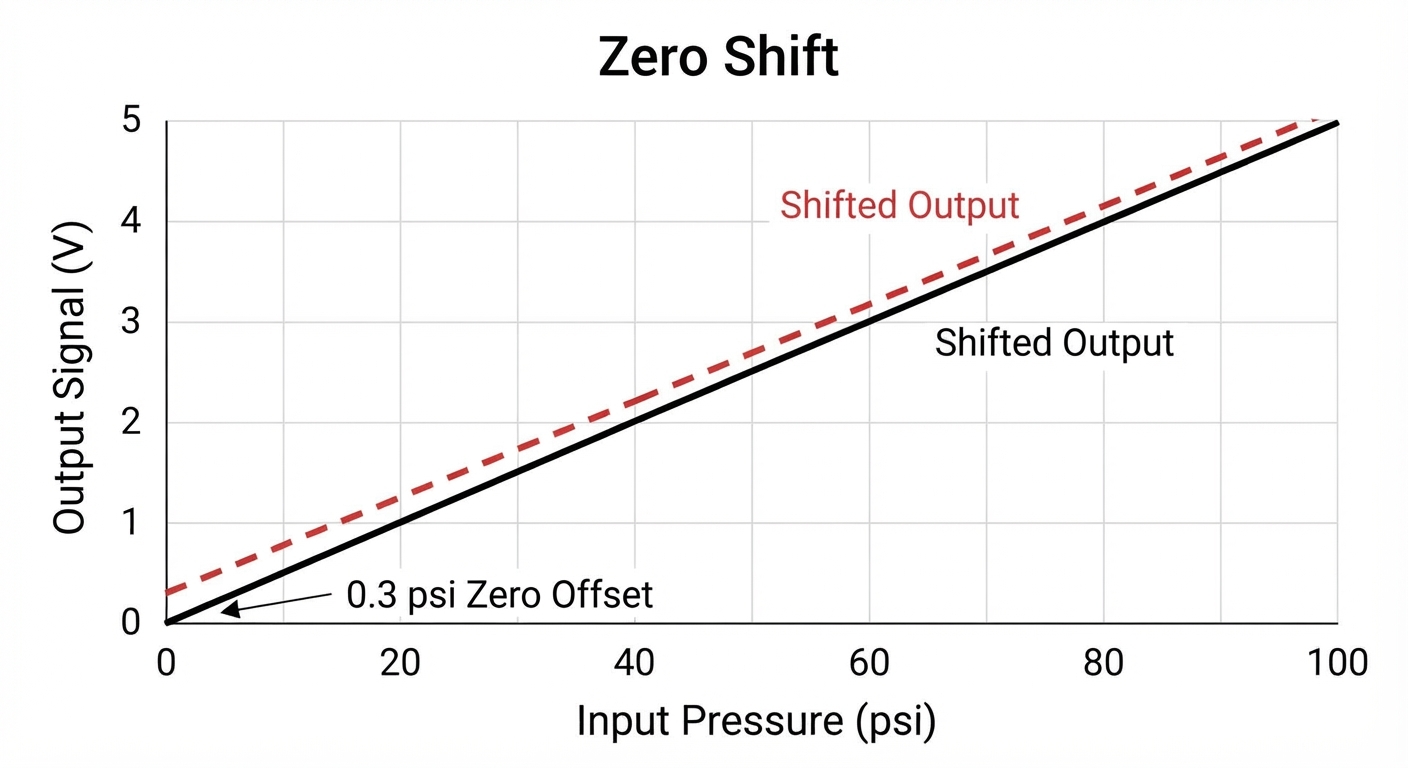
Pressure Sensor Zero Shift vs Span Shift and Nonlinearity
These three get conflated constantly, and distinguishing them narrows the cause list considerably.
| Error type | What it looks like | Example |
|---|---|---|
| Zero shift | A constant offset. Every reading is wrong by roughly the same amount. | Reads 0.3 psi at atmosphere and about 100.3 psi at 100 psi. |
| Span shift | A change in sensitivity. Zero may still be correct, but error grows with pressure. | Correct at 0, off by 2 psi at 100. |
| Nonlinearity | Error varies irregularly across the range, with no consistent offset or slope. | Correct at 0 and 100, off by 1.5 psi at 50. |
Checking at two or three points rather than only at zero tells you which you have. Pure offset points toward mounting stress, electrical offset, or moderate overpressure. Offset combined with span change usually indicates more significant diaphragm damage.
Temporary Versus Permanent Pressure Sensor Zero Shift
The second question worth answering early: does the offset go away?
Temporary shift disappears when the causing condition is removed. Thermal zero shift is the clearest example. The sensor reads offset at 60°C and returns to normal at room temperature. Nothing is damaged; the device is behaving according to its temperature coefficient. Our article on pressure sensor temperature effects covers this mechanism in detail.
Permanent shift persists after conditions return to normal. This indicates a physical change: plastic deformation of the diaphragm, a damaged bond, or altered mounting stress.
Distinguishing the two often just means letting the sensor return to reference conditions and rechecking. It is a cheap test that eliminates a large fraction of the possible causes of pressure sensor zero shift before you touch anything else.
Mechanical Causes of Pressure Sensor Zero Shift
- Overpressure. The most common cause of permanent shift. Pressure beyond the elastic limit deforms the diaphragm so it no longer returns to its original shape. Transient spikes can do this without ever appearing on a gauge, as covered in our article on pressure spike damage.
- Diaphragm deformation. The physical mechanism behind most overpressure shift, and it may also result from freezing media or mechanical impact.
- Mounting stress. A sensor body distorted by its mounting transfers that strain to the sensing element. Misaligned fittings, over-tightened brackets, and pipe strain all qualify. This one is fully reversible: loosen the mounting and the offset often disappears.
- Excessive installation torque. A specific and very common case of mounting stress. Torque past the point of sealing distorts the port and shifts zero. Installation practice for pressure instruments and their attachments is addressed in ASME B40.100, Pressure Gauges and Gauge Attachments, which covers snubbers, diaphragm seals, and the environmental factors worth considering before a device goes in.
- Mechanical shock. Drops during handling or impacts in service can crack bonds or shift internal components.
- Media contamination. Deposits, crystallization, or debris on the diaphragm add mass and stiffness, biasing the reading.
- Trapped pressure. Media sealed in the port at above atmospheric pressure means the sensor is correctly reporting a real pressure that you assumed was zero.
- Vent blockage. A gauge sensor references atmosphere through a vent. Block it and the reference becomes whatever pressure is trapped inside, which drifts with temperature.
[IMAGE PLACEHOLDER 2 – Alt text: “diagnosing pressure sensor zero shift by separating mechanical, electrical, environmental, and test-system causes”]
Electrical and Environmental Causes of Pressure Sensor Zero Shift
- Electrical offset. Drift in the signal conditioning circuitry produces an output offset with no mechanical change at all. In a piezoresistive device the offset originates in an unbalanced Wheatstone bridge, and published research on piezoresistor placement and sensor performance shows how strongly bridge balance influences both zero output and its behavior over temperature.
- Supply variation. Significant for ratiometric sensors, whose output scales with supply voltage. A supply that has drifted from 5.00 V shifts the apparent zero proportionally. Always measure supply voltage at the sensor, not at the power supply.
- Thermal zero shift. Every sensor has a temperature coefficient of zero. Within the compensated range this is small; outside it, it can be substantial.
- Aging and long-term stability. Materials relax over time, and packaging stress that was locked in during assembly gradually releases. A wind tunnel sensor study published in Microsystems & Nanoengineering tracked exactly this effect, with measurable zero drift change over three months at room temperature attributed to packaging stress relief. Datasheets typically specify this as an annual figure, and gradual shift over years may simply be the device performing to specification.
Test-System Errors That Look Like Pressure Sensor Zero Shift
Before concluding the sensor has changed, confirm that your measurement of it has not.
- Improper reference pressure. Absolute sensors do not read zero at atmosphere; they read atmospheric pressure, which varies with weather and elevation. Standard sea level pressure is about 14.7 psi, and as NOAA’s JetStream reference on air pressure explains, the ambient value moves continuously with weather systems and drops with altitude. An absolute sensor reading 14.5 psi at sea level is correct. Sealed gauge devices reference a fixed pressure that may not match local atmosphere either.
- Calibration equipment error. Your reference standard drifts too. If it has not been verified recently, the shift may be in the reference rather than the unit under test. A defensible check depends on an unbroken chain of comparisons back to a national standard, which is what NIST describes as metrological traceability.
- Measurement setup differences. Different DMM, different loading, different lead resistance, different orientation. Orientation matters for many sensors, since the weight of the diaphragm and any fill fluid changes with position.
Quick Reference: Symptom to Likely Cause
Use this table to narrow a case of pressure sensor zero shift to two or three candidates before you start testing.
| What you observe | Most likely causes | Fastest test |
|---|---|---|
| Offset appeared immediately after installation | Installation torque, mounting stress, trapped pressure | Remove the sensor and measure zero unstressed |
| Offset tracks temperature and reverses on cooling | Thermal zero shift within or outside the compensated range | Record temperature at each reading and compare to the compensated range |
| Offset plus a span change | Overpressure, diaphragm deformation, freeze damage | Check at three or more pressure points |
| Offset scales with supply voltage | Supply variation on a ratiometric output | Measure supply at the sensor, not at the power supply |
| Absolute sensor reads about 14.7 psi at rest | Nothing. Correct behavior for an absolute reference | Confirm the reference type on the part number |
| Offset drifts slowly over months or years | Aging, packaging stress relief, vent partially blocked | Compare against the datasheet long-term stability figure |
How to Diagnose Pressure Sensor Zero Shift, Step by Step
- Confirm the reference type. Gauge, sealed gauge, or absolute? An absolute sensor is supposed to read atmospheric pressure at rest. This resolves a surprising number of reported cases immediately.
- Verify the port is actually at atmosphere. Confirm no trapped pressure and that the vent, if present, is clear.
- Measure supply voltage at the sensor. Compare against the datasheet. For ratiometric outputs, check whether the offset scales with supply.
- Record the temperature. Compare against the compensated range. If shift correlates with temperature and reverses on cooling, it is thermal rather than damage.
- Remove the sensor from its mounting. Measure zero with the sensor free and unstressed. If the offset disappears, the cause is mounting stress or installation torque.
- Inspect the diaphragm and port. Look for deposits, debris, corrosion, or visible deformation.
- Check at multiple pressure points. Determine whether this is pure offset or offset plus span change. Span change points to more significant damage.
- Verify the reference standard. Check your calibration equipment against a known-good sensor, or confirm its calibration is current and traceable.
- Review the history. Any known overpressure event, freeze, impact, or process upset that coincides with when the shift appeared?
For the broader diagnostic context including no-output and erratic-reading faults, see our pressure sensor troubleshooting guide.
When Recalibration Will Not Help
Recalibration compensates for an offset. It does not repair anything, and whether it is the right response to pressure sensor zero shift depends entirely on the cause.
It is reasonable for normal aging drift within specification, or for a stable offset with no underlying damage. It is not a solution when the diaphragm has been plastically deformed, since linearity and hysteresis may also have changed and the device may continue to drift. It also will not help when the real cause is mounting stress, a blocked vent, a supply problem, or a reference error, because in those cases the sensor is not the thing that changed. Calibrating around an installation problem hides it until it moves again.
The same logic applies to a software or firmware zero offset applied at the controller. Removing a number from the display does not make the underlying measurement trustworthy, and it removes the evidence you would need to spot a developing fault.
Pressure Sensor Zero Shift FAQ
Can every zero shift be fixed by recalibrating?
No. Recalibration handles a stable offset from normal aging, but it cannot repair a deformed diaphragm, and a sensor damaged by overpressure may continue drifting after adjustment. It also does nothing about mounting stress, vent blockage, or supply problems, where the sensor itself is behaving correctly.
My absolute sensor reads about 14.7 psi with nothing connected. Is it broken?
Almost certainly not. An absolute sensor measures against a sealed vacuum reference, so at rest it correctly reports atmospheric pressure. That reading will vary with weather and elevation. Only a gauge sensor should read zero at atmosphere.
The offset appeared right after installation. What is the likely cause?
Installation torque or mounting stress is the first thing to check. Removing the sensor and measuring zero with it unstressed will confirm or eliminate this in a few minutes. Trapped pressure in the port is the other common possibility.
How much zero shift is acceptable?
That depends on the datasheet rather than on any universal figure. Look for the long-term stability specification, usually given as a percentage of full scale per year, and the temperature coefficient of zero over the compensated range. Pressure sensor zero shift that falls inside both is the device performing as specified. A shift that appears suddenly, or that exceeds the annual stability figure in a matter of weeks, is worth investigating regardless of its absolute size.
When should the sensor be replaced instead of adjusted?
Replace it when the offset is accompanied by a span change or worsening nonlinearity, when the shift keeps growing after adjustment, or when there is visible diaphragm deformation or corrosion. Those all indicate physical damage, and an adjusted reading from a damaged element is not stable enough to rely on.
Can a blocked vent really cause zero shift?
Yes, and it is easy to miss. A gauge sensor compares process pressure against atmosphere through a vent path, often a small filter in the cable or housing. If moisture, ice, paint, or debris seals that path, the sensor starts referencing whatever pressure was trapped inside instead, and that trapped volume expands and contracts with temperature. The result usually looks like a wandering zero rather than a fixed one.
Get Help Diagnosing Pressure Sensor Zero Shift
Phoenix Sensors is a US-based custom OEM sensor manufacturer, and our engineering services team can help work through a persistent offset.
The most useful information to share: the original baseline output, the current output, the pressure history including any suspected overpressure events, the temperature history, how the sensor is mounted and at what torque, and the sensor part number. With that, it is usually possible to narrow the cause considerably before anyone opens anything up. Send us those details to get started.