
Pressure sensor vibration does not have to break a sensor on day one to cause a failure. It can fatigue the weakest point in the assembly over millions of cycles: a solder joint, a connector contact, a cable conductor at the strain relief, or a mounting thread. The result can be an intermittent signal or a dead sensor months after the design passed bench testing.
The numbers add up quickly. A part vibrating at 500 Hz goes through 1.8 million load cycles every hour, or about 43 million in a day of continuous running. This guide covers where pressure sensors can fail under vibration, what makes the problem worse, and what OEM engineers can check in the mounting, cable, connector, and test plan before a design reaches the field.
Key Takeaways for OEM Engineers
- Treat the sensor, mounting, connector, and cable as one mechanical assembly.
- Look for resonance, not only the overall vibration level. Resonance can amplify vibration many times over.
- Validate with a vibration profile and a mounting setup that represent the real application.
- Read any vibration rating together with the test conditions behind it.
In this guide: Failure points | What makes it worse | Mounting and cable support | Warning signs | Testing | Design checklist | Questions for suppliers | FAQ
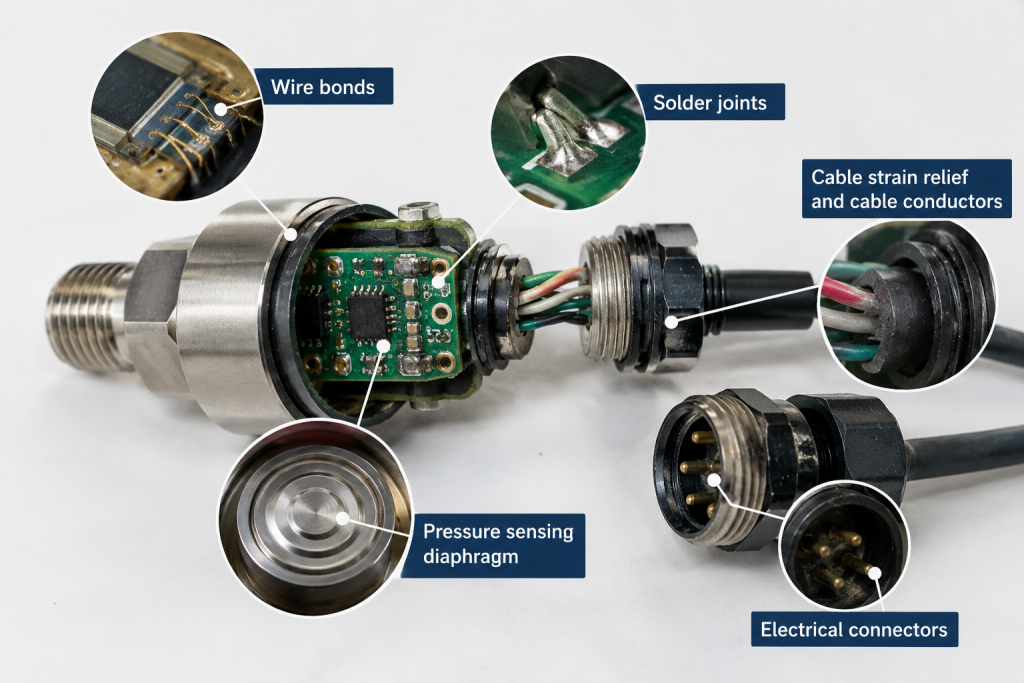
What Vibration Can Damage Inside a Pressure Sensor
The vulnerable components depend on the sensor construction and installation, but several areas commonly deserve attention.
| Failure point | How vibration can damage it | What it can look like in the field |
|---|---|---|
| Wire bonds and internal connections | Repeated movement can fatigue fine internal connections over time. | An open circuit with no visible external damage. |
| Solder joints | Board and component flexing can crack joints or make them intermittent. | Output that cuts in and out while the equipment is running. |
| Connectors | Micro-motion between mated contacts can lead to fretting, which is wear and oxidation at the contact surface. | Rising electrical noise or brief signal dropouts. |
| Cable conductors and strain relief | Unsupported cable creates repeated bending loads near the cable exit, which can eventually damage conductors. | A broken or intermittent conductor close to the sensor body. |
| Mounting hardware and fittings | Vibration can loosen threads and brackets or add stress to the installation. | Loose fittings, leaks, or repeat failures at one mounting location. |
| Circuit boards, seals, and potting | These may also be affected, depending on the sensor design. | Depends on the design. |
What Makes Pressure Sensor Vibration More Damaging?
A vibration environment cannot be described by acceleration alone. Frequency, amplitude, direction, duration, mounting, and resonance all change the mechanical stress that reaches the pressure sensor.
Frequency and Amplitude
Higher vibration frequencies create more loading cycles in a given period. For example, a part vibrating at 500 Hz goes through 1.8 million cycles per hour. Higher acceleration or displacement can also increase the stress applied during each cycle.
Resonance
Resonance is particularly important because vibration can be amplified when an excitation frequency approaches the natural frequency of part of the assembly. In a simple single degree of freedom model, a damping ratio of 5% gives roughly tenfold amplification at resonance.
The resonating part may not be the sensor itself. It could be the mounting bracket, the cable, the connector, a circuit board, or another part of the installation. This is one reason two sensors exposed to similar overall vibration levels can experience very different results.
Mass matters as well. For a given acceleration, a heavier sensor body or a longer unsupported length of cable puts more inertial force on whatever supports it.
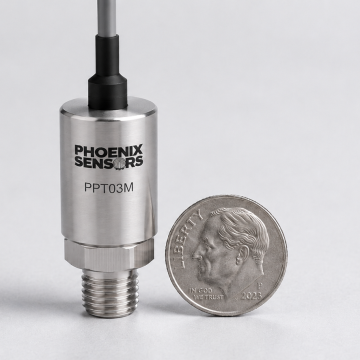
Phoenix Sensors product example
Compact Body: PPT03M Miniature Pressure Transducer
Available space can influence how the sensor, cable, and strain relief are integrated into vibrating equipment. The PPT03M miniature pressure transducer has a 0.65 inch diameter SS316L body with 26 AWG flying leads and heat-shrink strain relief, and it is available with analog or digital output for space-constrained OEM designs.
Random vs. Sinusoidal Vibration
Vibration tests are commonly defined as sinusoidal or random, and the two are not interchangeable.
| Sine vibration | Random vibration | |
|---|---|---|
| What it is | One frequency at a time, which can be swept across a range. | Many frequencies at once across a band. |
| Typical use | Finding resonant frequencies and studying the response at specific frequencies. | Representing equipment exposed to multiple vibration sources. |
| How it is specified | A frequency range with acceleration in g or displacement. | A PSD profile in g²/Hz across a frequency band, summarized as gRMS. |
| Published test methods | IEC 60068-2-6 | IEC 60068-2-64 |
PSD (power spectral density) shows how vibration energy is spread across frequency. gRMS is a single number for the overall level of a random profile, equal to the square root of the area under the PSD curve. Two profiles with the same gRMS can stress an assembly very differently if their energy sits at different frequencies.
The useful question is not which test is better. It is whether the test profile represents the actual application.
How Mounting and Cable Support Affect Pressure Sensor Vibration
The installation can contribute more to a vibration problem than the pressure sensor itself. Three decisions deserve attention early in the design.
- Cable support. An unsupported cable can behave like a moving mass, repeatedly loading the cable exit and strain relief. Supporting the cable close to the sensor body can reduce this bending load and is often a simple reliability improvement.
- Electrical connection. A threaded connector such as an M8 or M12 gives a locked connection that can be disconnected for service. With flying leads there is no mated connector at the sensor, so cable loads go directly into the cable exit and strain relief. The right choice depends on the equipment and how it is serviced.
- Sensor location. Where the application allows it, remotely mounting the pressure sensor with suitable tubing or a flexible pressure connection can reduce vibration transmitted directly from equipment such as pumps, motors, compressors, and engines. Remote mounting does require additional consideration because tubing length and volume can affect pressure response, damping, and dynamic measurements.
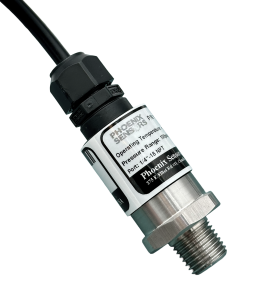
Phoenix Sensors product example
Connection Options: PPT67 Configurable Pressure Transducer
The PPT67 configurable industrial pressure transducer is available with flying leads or an M8 A-coded connector. It is rated IP65 as standard and IP67 with a cord grip or the connector. Process connections include NPT, UNF, and BSPP, with analog, 4 to 20 mA, or digital output. Phoenix Sensors also offers custom cable assemblies.
Signs of a Vibration-Related Sensor Problem
- Intermittent output while equipment is running
- Signal dropouts at certain motor, pump, compressor, or engine speeds
- Increasing electrical noise over time
- Repeated failures at one mounting location
- Loose mounting hardware or fittings
- An open circuit with no obvious external damage
Problems that repeatedly appear at a particular operating speed deserve additional attention because the system may be passing through a resonant condition.
Before concluding that vibration is responsible, rule out basic electrical and installation issues with our pressure sensor troubleshooting guide.
Seeing these symptoms on equipment in the field? Email the symptoms, the operating speed where they appear, and a photo of the mounting to [email protected], or use our contact form. Phoenix Sensors can review the application with you.
Why Bench Testing Can Miss Pressure Sensor Vibration Failures
A standard functional bench test determines whether a pressure sensor operates correctly under controlled conditions. It provides very little information about how the sensor will respond to millions of mechanical loading cycles in the field. This is one of the reasons pressure sensors can fail after passing bench testing.
Meaningful vibration validation should consider the actual vibration spectrum, acceleration level, direction, mounting configuration, cable routing, temperature, and expected exposure time.
Standards such as IEC 60068-2-6 and IEC 60068-2-64 provide methods for sinusoidal and broadband random vibration testing. Military and aerospace applications may also use environmentally tailored testing approaches such as MIL-STD-810.
Vibration Rarely Occurs Alone
Real equipment may combine vibration with pressure cycling, elevated temperature, mechanical shock, and harsh media. A test that evaluates only one environmental condition may not represent the stresses experienced by the installed pressure sensor. Temperature also affects sensor output on its own, as covered in our article on pressure sensor temperature effects.
Passing one vibration test does not make a pressure sensor universally vibration resistant. Qualification demonstrates performance under the conditions and configuration that were actually tested.
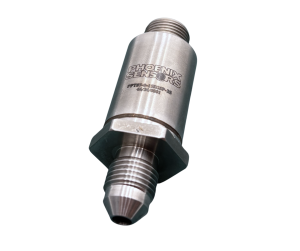
Phoenix Sensors product example
High Pressure and High Temperature: PPT87
The PPT87 autoclave pressure transducer is a Phoenix Sensors platform for demanding OEM applications that combine high pressure and high temperature. It covers pressure ranges up to 20,000 PSI and operating temperatures from -40°C to 150°C, with SS316/SS316L stainless steel construction, a media-isolated MEMS sensing element, and flying lead, Molex, or M12 electrical connections.
Pressure Sensor Vibration Design Checklist
Use these questions during design review, before the sensor configuration is frozen.
- Has the actual vibration environment been measured or characterized?
- Are the important frequencies, acceleration levels, and vibration directions known?
- If random vibration is present, are PSD or gRMS values available?
- Is mechanical shock present in addition to vibration?
- Does the test mounting represent the actual installation?
- Have the sensor, bracket, connector, and cable been evaluated as one assembly?
- Is the cable supported near the sensor body?
- Could another mounting location reduce vibration exposure?
- Could remote mounting work without compromising pressure response?
- Will the sensor experience vibration and temperature extremes at the same time?
There is no single vibration rating that guarantees a pressure sensor will work in every installation. Mounting, cable configuration, frequency content, temperature, and surrounding equipment can all change how vibration reaches the sensor.
For the other selection factors, including pressure range, output signal, process connection, and media compatibility, see our pressure sensor selection guide.
Questions to Ask a Supplier About Pressure Sensor Vibration
A vibration rating is easier to evaluate when you know the conditions behind it. These questions can help compare suppliers on equal terms.
- What vibration and shock levels has this sensor been tested to, and with which test method?
- Was it tested in the mounting orientation, and with the connector and cable, that I plan to use?
- How is the cable exit strain relieved, and where should the cable be supported?
- Which electrical connection do you recommend for my vibration environment, and why?
- Can the sensor, cable, or connector be configured or customized if my profile is more severe?
- What information do you need from me to review the application?
Working Through a Vibration Requirement?
If you already have vibration specifications, mounting drawings, or field failure information, Phoenix Sensors can review the application requirements with you before you select a pressure sensor configuration.
Prefer email? Send your specification or drawing to [email protected].
FAQ: Pressure Sensor Vibration
Can vibration cause a pressure sensor to fail?
Yes. Depending on the sensor construction and installation, repeated vibration can contribute to fatigue in electrical connections, solder joints, cables, connectors, mounting components, and other parts of the assembly.
Why can a pressure sensor pass vibration testing and still fail in the field?
The laboratory test may not match the actual frequency spectrum, mounting method, cable support, vibration direction, temperature, duration, or surrounding equipment experienced in service. Even the test fixture can change the resonant behavior of the assembly.
Is random vibration testing better than sine testing?
Not necessarily. Sine testing can help identify resonant frequencies and study response at particular frequencies. Random vibration distributes energy across a broader spectrum and may better represent environments with multiple vibration sources. The appropriate test depends on the actual application.
What is gRMS in a pressure sensor vibration specification?
gRMS is the root mean square acceleration of a random vibration profile, expressed in g. It summarizes the overall level in one number and equals the square root of the area under the PSD curve. It does not describe how the energy is distributed across frequency, so it should be read together with the PSD profile.
What can reduce vibration reaching a pressure sensor?
Start with the installation. Supporting the cable, improving mounting, changing the sensor location, reducing unsupported mass, or remotely mounting the sensor may reduce vibration exposure. The appropriate approach depends on the pressure dynamics and mechanical environment of the system.
What vibration information should I give a pressure sensor supplier?
At a minimum, share the frequency range, the acceleration level or PSD profile, the test axes, any shock requirement, the operating temperature, and how the sensor will be mounted and cabled. If the environment has not been measured, describe the equipment and operating speeds so the supplier can ask the right follow-up questions.
Have a High-Vibration Pressure Sensor Application?
Send Phoenix Sensors the application information you already have. You do not need every item to start the conversation.
- Vibration frequency range, PSD profile, or test specification
- Acceleration level or gRMS, test axes, and any shock requirement
- Pressure range, pressure type, and process media
- Process connection and available installation space
- Minimum and maximum operating temperature
- Required analog or digital output
- Cable, connector, and strain-relief preferences
- Field failures or symptoms already observed
- Prototype and estimated production quantities
Phoenix Sensors is a U.S.-based OEM sensor manufacturer supporting custom and configurable pressure sensor programs. Final suitability should always be validated under the actual application conditions rather than assumed from a single specification.
Or email [email protected] or call (480) 462-1810.