
Home | Applications |
Commercial oven sensors give foodservice equipment OEMs the temperature feedback their controls need to cook consistently and shut down safely. We design and manufacture RTD, thermocouple, and NTC temperature sensors for convection, combi, deck, conveyor, rack, and rapid-cook ovens.
We are a U.S.-based sensor manufacturer in Chandler, Arizona. We support commercial kitchen equipment OEMs with new designs, second-source parts, and replacements for obsolete sensors, from first prototype through production.
Why commercial oven sensors matter in foodservice equipment
A commercial oven runs long shifts with its door opening constantly. Every opening dumps heat. Every full load of cold product pulls the cavity temperature down. The control has to see those changes quickly and respond without overshooting.
That is the job of the sensors. Cavity temperature feedback drives heating elements, gas burners, and convection fans. Surface sensors watch heating elements, burner housings, and baking decks. Combi ovens add steam generators and drains that need their own monitoring. Control electronics need protection too, because a hot kitchen is hard on circuit boards.
Accurate oven temperature sensing matters well beyond product quality. Retail food safety is built around reaching required cooking temperatures, as outlined in the FDA Food Code. Efficiency matters too. The ENERGY STAR key product criteria for ovens set cooking energy efficiency, idle energy rate, and water consumption requirements. Tight sensor feedback helps an oven hold setpoint without wasting energy or water.
Applications for commercial oven sensors
The table below maps common measurement points to the sensor types OEMs use and where our products fit.
| Measurement point | What it controls | Common sensor types | Phoenix Sensors fit |
|---|---|---|---|
| Cavity air temperature | Heating, preheat, setpoint | Type J or K thermocouple, Pt1000 RTD, high-temperature thermistor | PRTD10-1K-FG (standard or SS316L) |
| Food core temperature | Cook-to-temperature programs | RTD or thermocouple needle probe | Custom RTD or thermocouple core probe |
| Deck, element, and burner surfaces | Deck heat, overheat detection | Surface thermocouple | PTC-WT |
| Steam generator | Steam heating, low-water protection | Level electrodes, temperature probe, thermal limiter | Custom temperature probe |
| Drain or vent line | Cold-water quench | Temperature probe | Custom temperature probe |
| Control compartment and fan motors | Cooling fans, derating, alarms | NTC thermistor | PTS31 |
Cavity temperature control
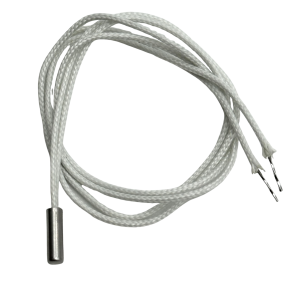
The cavity sensor is the most important of all commercial oven sensors. It is the main input to the oven control. OEMs use several sensor types here, including Type J and K thermocouples, platinum RTDs, and high-temperature thermistors. The right choice usually follows the input your controller already reads.
When you want the stability of a platinum RTD, the PRTD10-1K-FG 1KOhm RTD Probe Sensor is built for it. This thin-film Pt1000 sensor is laser trimmed to ±0.3°C accuracy at 0°C. Ovens and baking are among its listed applications. It ships fully assembled with 12-inch, 28 AWG fiberglass-insulated leads, so there are no fragile splices or extra terminations.
It comes in two versions:
- Standard version: a high-purity alumina housing with ceramic potting, Ø0.095″ x 0.25″, rated from -75°C to 400°C (-103°F to 752°F)
- SS316L version: a 316L stainless steel housing, Ø0.118″ x 0.25″, rated from -75°C to 540°C (-103°F to 1004°F)
The SS316L version suits the hottest cavity locations and adds a tougher metal housing. The standard version is slightly smaller for tight probe sheaths. Either one can be built into a finished cavity probe with your sheath, fitting, cable, and connector. Like any RTD, accuracy widens as temperature rises, so check the tolerance at your operating point. For the SS316L version, it is ±1.2°C at 200°C and ±1.8°C at 300°C. Full specifications are on the PRTD10-1K-FG product page.
Keep in mind that a probe’s rating depends on the full assembly, not just the element. Lead wire insulation, potting, cable, and seals all set the real temperature limit. Probe location matters as well. A sensor near a heating element or fan outlet reads differently than one in the center of the cavity.
Food core temperature probes
Many combi and convection ovens include a core probe that the operator inserts into the product. The oven can then cook to a target internal temperature instead of a fixed time. Some designs use several sensing points along the needle to find the coldest spot in the product.
Core probes are among the hardest-working commercial oven sensors. They see repeated insertion, steam, cleaning chemicals, and rough handling. Tip geometry, sheath material, cable flexibility, and strain relief all affect probe life. We can design custom RTD or thermocouple core probes around your handle, cable, and connector requirements. We can also deliver the probe and harness as one tested part.
Heating elements, burners, and baking decks
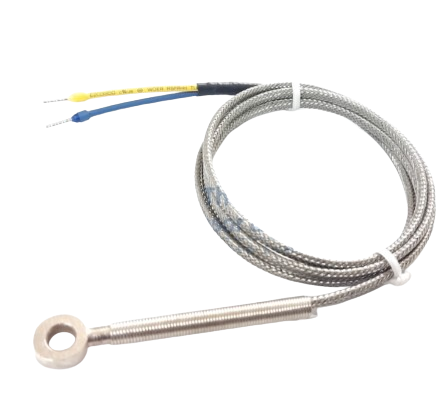
Surface temperatures matter on deck ovens, cooking plates, burner housings, flue collars, and element mounting brackets. A thermocouple is often the practical choice for these hot, tight locations.
The PTC-WT Washer Type Thermocouple mounts under an existing bolt or screw, so it needs no clamps or adhesives. It offers Type J and Type K options and a -50 to 600°C range. The stainless steel washer comes in #6, #8, or #10 sizes, and lead lengths are customizable. It is built to withstand moisture, vibration, and thermal cycling. See the PTC-WT datasheet for full specifications.
For any surface sensor, thermal contact decides accuracy. A loose fastener, a painted surface, or an uneven mounting face can cause a large reading error.
Steam generators and combi oven drains
Combi ovens add steam, which brings its own sensing points. Level electrodes in the steam generator tell the control when to fill. A temperature sensor tracks the generator, and a thermal limiter cuts heating power if it runs dry or overheats. Many designs make steam at atmospheric pressure, so temperature and level sensing carry most of the load.
Steam leaving the cavity needs attention too. A temperature probe in the drain or vent line can trigger a cold-water quench, so hot condensate does not damage building drains. These probes see hot water, steam, and scale, so sheath material, sealing, and response time all matter. We can build custom stainless temperature probes for steam generator and drain locations.
Burners, airflow, and exhaust
Gas ovens with power burners often use an air pressure switch to prove combustion airflow before ignition. Convection ovens of every fuel type depend on fan airflow to cook evenly. Flue and exhaust temperature sensing can flag a blocked flue or a burner that is running poorly.
These measurements support service and diagnostics. They do not replace the listed flame safeguards, gas valves, and limit controls that your appliance standards require.

Control electronics and over-temperature protection
Control boards, relays, contactors, and motor drives often sit close to a hot cavity. Commercial oven temperature sensors in the electronics compartment can switch on cooling fans or derate the oven before components overheat.
The PTS31 Ring Lug NTC Temperature Sensor mounts under a screw on a heat sink, bracket, or chassis point. Commercial ovens are one of its listed applications. Its lug-style, glass-encapsulated NTC is designed for high-vibration environments. It operates from -50°C to 150°C and carries an IP65 rating. That makes it a practical fit for control compartments, fan motor mounts, and cabinet surfaces, though not the cooking cavity itself. Details are in the PTS31 datasheet.
Independent high-limit protection is normally a separate, listed device. We can help you choose sensing points that support your control strategy. Your safety architecture should still be reviewed against the standards that apply to your oven.
Replacing a sensor on an existing oven platform? Send us the part number, datasheet, or a sample. We compare the thermocouple type or resistance curve, range, lead length, mounting, and connector. Then we recommend a standard or custom equivalent for your validation. Our obsolete part replacement guide walks through the same process, using pressure transducers as the example.
Custom sensor solutions for foodservice equipment OEMs
Few commercial oven sensors are used exactly as they appear in a catalog. Cavity layouts, mounting points, cable routing, and connector choices vary from model to model. We can evaluate and customize:
- Sensor type to match your controller input: Pt1000 or Pt100 RTD, Type J or K thermocouple, or NTC curve
- RTD accuracy class and thermocouple junction style
- Probe sheath material, length, diameter, tip style, and mounting fitting
- Lead wire, cable jacket, and insulation materials for hot cable routing
- Connectors, strain relief, and complete wire harnesses
- Sealing for steam, grease, washdown, and cleaning chemicals
- Labeling and part marking for service traceability
- Prototype, pilot, and production quantities
Commercial oven sensors face steam, grease, cleaning chemicals, thermal cycling, fan vibration, and frequent handling during service. We do not claim that standard Phoenix Sensors products are automatically listed or certified for commercial cooking equipment. Requirements under standards such as UL 197, ANSI Z83.11/CSA 1.8, or NSF/ANSI 4 apply to your complete appliance. We review those requirements during quoting, so materials and construction suit your certification path.
Our engineering and manufacturing teams work under one roof in Chandler, Arizona, including in-house custom cable assemblies. Many standard parts, including the PRTD10-1K-FG, are also stocked at DigiKey for quick evaluation samples.
Commercial oven sensors that support efficiency and uptime
Downtime in a busy kitchen is expensive. When an oven fails during service, the menu shrinks and the line backs up. Good sensing helps prevent that. Cavity temperature trends can reveal a weakening element or a failing fan. A clear fault code for an open or shorted probe sends the technician straight to the right part. Better diagnostics shorten service calls and reduce unnecessary parts replacement.
Sensor accuracy also affects energy use. An oven that overshoots or cycles widely uses more energy than one that holds setpoint closely. Choosing an RTD for your control? Our guide on how to select the right RTD for your OEM application walks through the main selection factors.
Many foodservice OEMs build both hot and cold equipment. For the cold side of the kitchen, see our commercial refrigeration sensors for OEM equipment.
Frequently asked questions
Most commercial ovens use a cavity temperature sensor as the main control input. It is usually a Type J or K thermocouple, a platinum RTD, or a high-temperature thermistor. Many ovens add surface sensors on decks or burners, a food core probe, and an electronics compartment sensor. Combi ovens also use steam generator level electrodes and temperature sensors, plus a drain temperature sensor.
RTDs offer stable, repeatable readings and suit cavity control and core probes. Thermocouples handle higher temperatures, cost less, and fit tight surface locations. Many ovens use both. The right choice depends on temperature range, accuracy target, response time, and the input your controller reads.
Often, yes. Send us the part number, thermocouple type or resistance curve, lead length, and connector. We compare them against our standard products and recommend a standard or custom equivalent for your validation.
Yes. We can customize sensing elements, probe dimensions, mounting fittings, lead wire, cables, and connectors. Final suitability depends on engineering review and validation in your oven.
Listings such as UL 197, ANSI Z83.11/CSA 1.8, and NSF/ANSI 4 apply to the complete appliance, not the sensor alone. We review your certification requirements during quoting so materials and construction suit your path to listing.
Discuss your commercial oven sensor requirements
The fastest way to get a useful recommendation is to share your actual operating conditions. Helpful information includes:
- Oven type, fuel, and controller input type
- Measurement points and required temperature ranges
- Normal and maximum cavity, surface, and ambient temperatures
- Required accuracy and response time
- Probe dimensions, mounting method, cable length, and connector
- Exposure to steam, grease, and cleaning chemicals
- Applicable listing and certification requirements
- Current part number, if you are replacing a sensor
- Prototype quantity and estimated annual volume
Commercial kitchen equipment OEMs are welcome to send drawings, current part numbers, and controller specifications. Contact our engineering team to review your oven application.