
Home | Applications |
Commercial refrigeration sensors give your controllers the pressure and temperature data they need to run compressors, defrost, and cases. We design and build pressure transducers, pressure switches, and temperature probes for refrigeration OEMs. That includes new low-GWP platforms and second-source replacements for sensors you use today.
We are a U.S.-based sensor manufacturer in Chandler, Arizona. Our engineering and manufacturing teams support your program from first prototype through high-volume production.
Why commercial refrigeration sensors matter
Your equipment runs around the clock in places your team rarely sees. Compressors cycle thousands of times. Coils frost over. Doors get propped open. Refrigerant slowly escapes from fittings and valves.
Commercial refrigeration sensors turn those conditions into data your controller can act on. Suction and discharge pressure drive compressor staging and head-pressure control. Coil and box temperatures tell the controller when to start and end defrost. Case temperatures confirm that food stays in a safe range.
When a sensor drifts or fails, your customer sees a warm case or a nuisance alarm. Your service team sees a warranty call. Choosing the right sensor at the design stage helps prevent both.
Applications for commercial refrigeration sensors
The table below maps common measurement points to the sensor type and the requirements that matter most.
| Measurement point | What it controls | Key requirements | Phoenix Sensors fit |
|---|---|---|---|
| Suction pressure | Compressor staging, superheat | Low-side range, refrigerant and oil compatibility | PPT82U |
| Discharge pressure | Condenser fans, high-pressure protection | High-side range, pressure spikes | PPT82U |
| Evaporator coil temperature | Defrost termination | Moisture sealing, freeze-thaw cycling | PTS11 |
| Walk-in box air temperature | Cooling cycles, alarms | Humidity, washdown, mounting | PTS11 |
| Display case air temperature | Case control, alarms | Condensation, door-opening swings | PTS11 |
| Low-side pressure cutout | Compressor protection | Switch point, cycle life, refrigerant compatibility | PSW03 |
| Water supply to ice machines or water-cooled condensers | Pressure proving before operation | Set-point tolerance, water service | PSW03 |
Refrigerant pressure on racks and condensing units
Refrigeration pressure transducers measure suction and discharge pressure on compressor racks, remote condensing units, and self-contained equipment. Suction pressure stages compressors and matches capacity to load. Discharge pressure controls condenser fans and guards against high head pressure.
Paired with a suction-line temperature, suction pressure also lets the controller calculate superheat. That value drives electronic expansion valve control and helps protect compressors from liquid floodback.
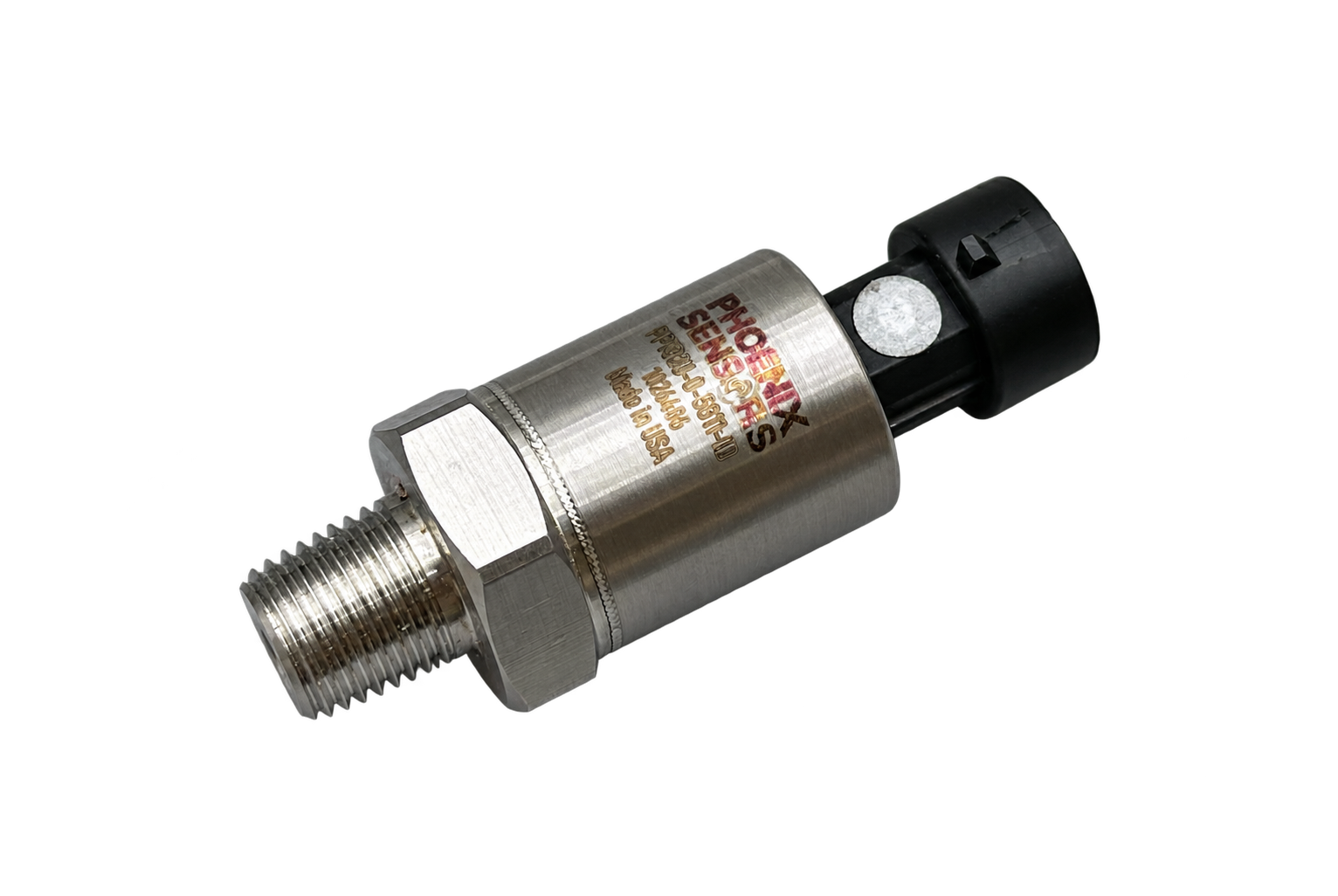
The PPT82U Rugged Pressure Transducer Made in the USA – Analog Output & Packard Connector is one option for these measurement points. It has a 316L stainless steel housing and wetted parts, a sealed Packard connector, and four analog output options. With the 5 V supply option, its voltage outputs are ratiometric, a format many refrigeration controllers use. Standard ports include 1/4 NPT, 1/8 NPT, and 7/16-20 UNF, and custom fittings are available for OEM programs. Refrigerant and oil compatibility should be confirmed for your system during quoting. Full specifications are in the PPT82U datasheet.
Pressure switches for compressor protection and water circuits
Not every refrigeration pressure sensor needs a continuous signal. A low-pressure cutout only needs to open a circuit when suction pressure drops too far. A water pressure switch only needs to confirm supply pressure before an ice machine or water-cooled condenser runs. A pressure switch handles these yes-or-no decisions without signal conditioning.
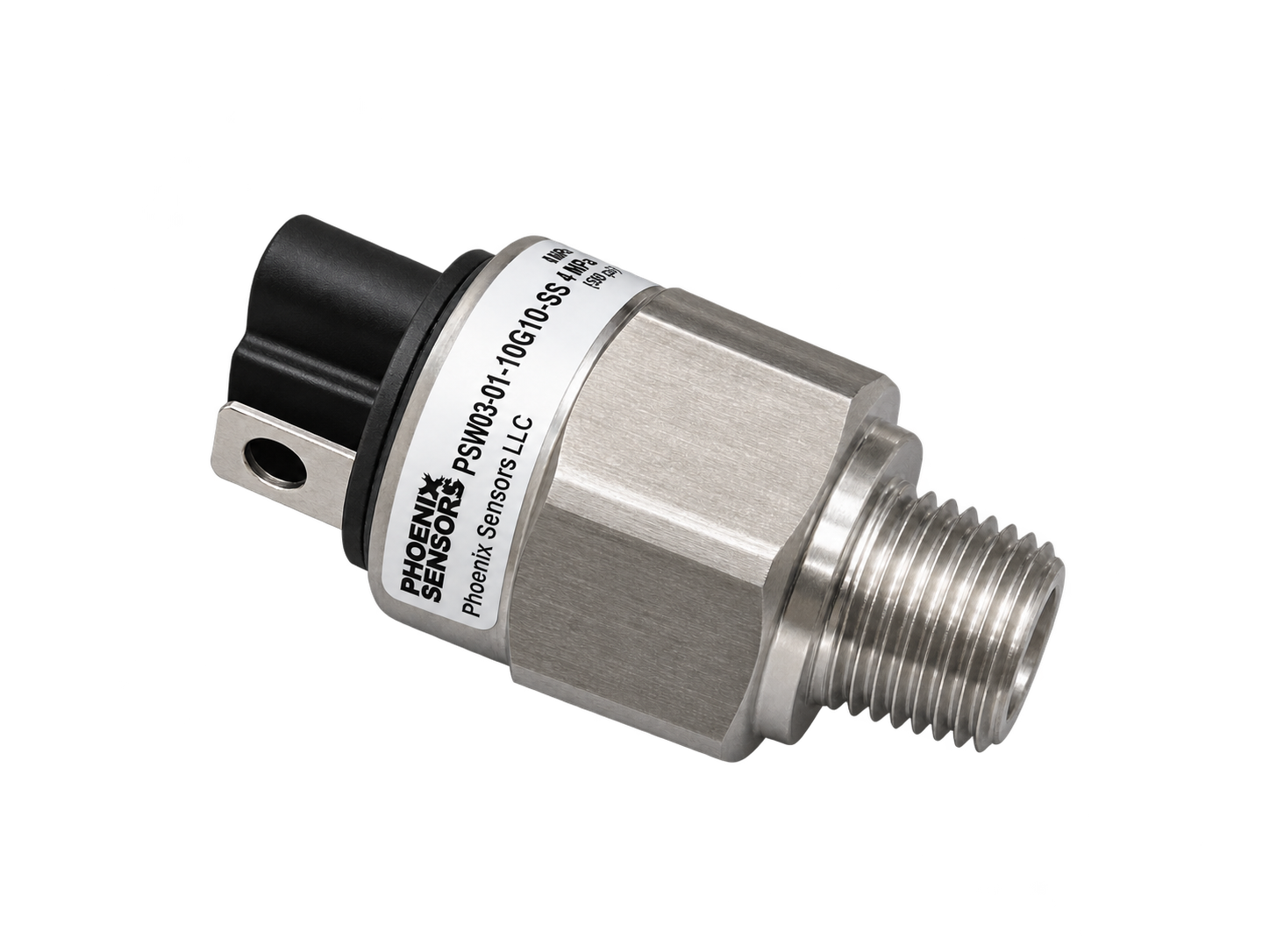
The PSW03 Stainless Steel Pressure Switch ships with its switch point set at our facility. It arrives ready to install. It has a 316L stainless steel housing, spade terminals, and normally open or normally closed contacts. Four ranges cover switch points from 5 to 300 psi, and the datasheet lists a cycle rating above 1,000,000 cycles. 7/16-20 UNF ports are available for OEM customers. Full specifications are in the PSW03 datasheet.
Those ranges suit low-side cutouts and water circuits. High-side cutouts on many refrigerants need higher settings. When a switch serves as a safety limit, confirm refrigerant compatibility and the agency listings your equipment requires.
Evaporators, defrost, and walk-in coolers
Refrigeration temperature sensors monitor box air, evaporator coils, and defrost termination in walk-in coolers and freezers. A coil sensor tells the controller when the frost has melted. Defrost then ends on time instead of running long. That saves energy and limits temperature swings in the box.
These locations are hard on sensors. They see condensation, frost, washdown, and repeated freeze-thaw cycles. Moisture that reaches the sensing element can cause drift. Drift can then trigger false defrost and alarm events in the field.
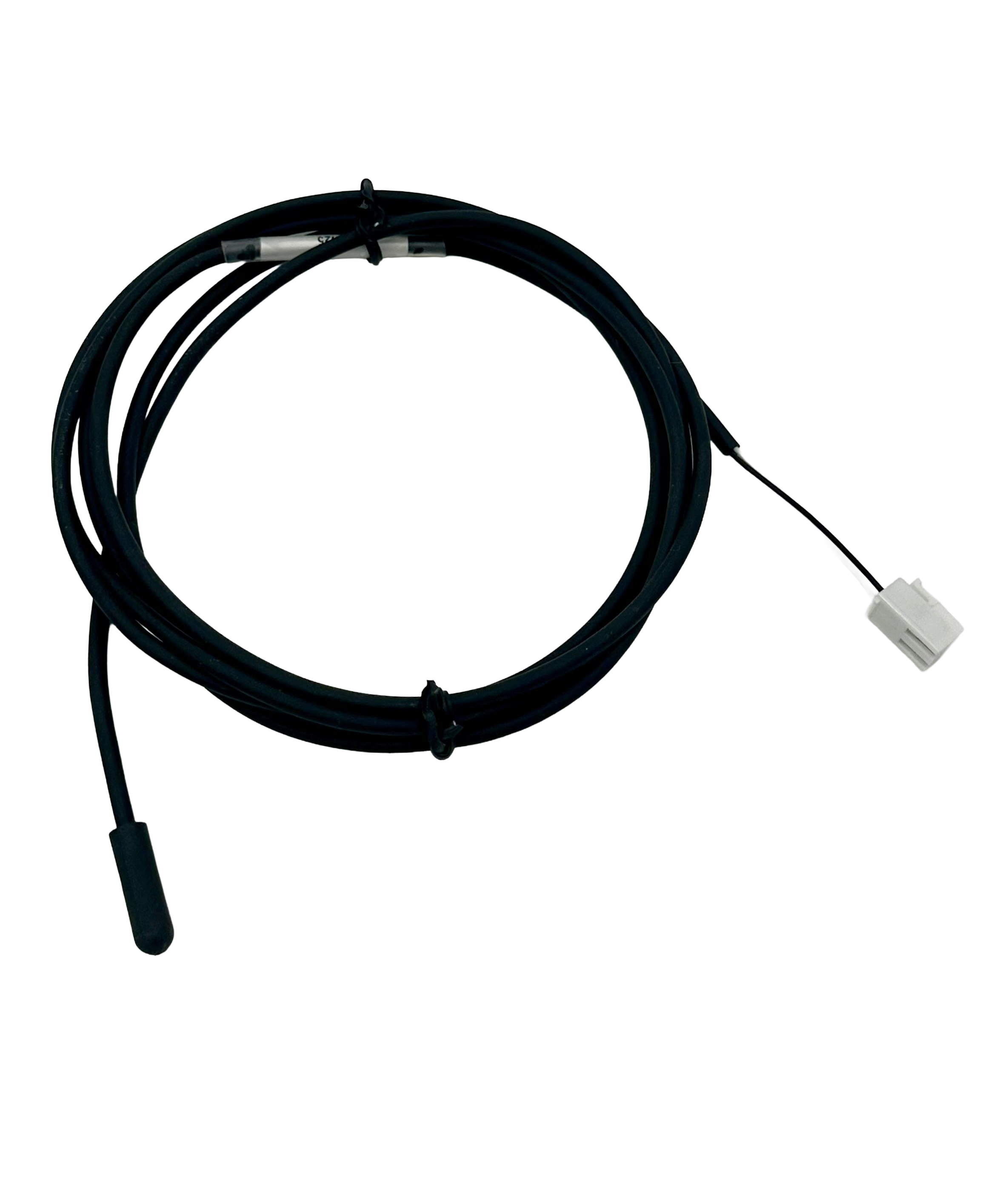
The PTS11 High Humidity NTC Temperature Probe is built for these conditions. Its glass-encapsulated NTC is overmolded for added protection against water ingress, and the probe is IP67 rated. An operating range of −50°C to 110°C covers coolers, freezers, and defrost cycles. Flying leads, AMP connectors, and several cable lengths are available. Resistance curves and dimensions are in the PTS11 datasheet.
Display cases and food safety
Display cases, reach-ins, and merchandisers need reliable temperature data at the product zone. The FDA Food Code sets a cold-holding limit of 41°F (5°C) or below for time/temperature control for safety foods. Many operators log case temperatures to show compliance.
Case sensors sit in cold, moving air and see condensation every time a door opens. Sealed refrigeration temperature sensors such as the PTS11 handle discharge air, return air, and product-zone locations. Placement matters as much as accuracy, so locate sensors where they reflect product temperature rather than door drafts.
Lower-GWP refrigerants and CO2 systems
Refrigerant choices are changing quickly. In May 2026, the EPA Technology Transitions Program finalized revised GWP limits for retail food refrigeration. New supermarket and remote condensing systems follow interim limits until tighter limits return in 2032.
Many OEMs are already designing around CO2 (R-744), hydrocarbons such as R-290, and A2L refrigerants. Each one changes the sensing requirements. Transcritical CO2 systems run at much higher pressures than traditional HFC systems. Flammable refrigerants can add requirements for electrical parts near the refrigerant circuit.
Selecting commercial refrigeration sensors early in a redesign helps you avoid late changes to ranges, ports, and approvals. We can review the refrigerant, operating pressure, and proof pressure needs with your engineering team.
Replacing a sensor on an existing platform? Send us the part number, and our engineers will recommend a match or a custom equivalent. Our guide to replacing an obsolete pressure transducer walks through the process.
Custom sensor solutions for refrigeration OEMs
Refrigeration OEMs rarely use an off-the-shelf sensor without changes. Controllers, harnesses, and mounting points differ from one platform to the next. Our custom sensor team can tailor:
- Pressure ranges for low-side, high-side, and CO2 applications
- Pressure ports, threads, and refrigeration fittings
- Wetted materials for your refrigerant and oil
- NTC curves, RTD elements, and probe housings
- Analog outputs, switch points, and contact types
- Connectors that mate with your existing harness
- Cable lengths, cable assemblies, and moisture sealing
- Prototype, pilot, and production quantities
We do not assume standard commercial refrigeration sensors are approved for every refrigerant or safety standard. Media compatibility, electrical safety, and agency listings must be confirmed for your final design. We review those requirements during quoting, so they are settled before production.
Reducing field failures and warranty claims
A sensor is a small line on your bill of materials. When it fails in the field, it becomes one of the most expensive parts on the unit.
Many refrigeration sensor failures in the field trace back to a few causes. Moisture reaches the sensing element. A connector seal fails. A pressure spike exceeds the proof rating. The output drifts outside the controller’s limits. Each one is easier to design out than to fix after shipment.
We help you match each sensor to the real installation: refrigerant, pressure spikes, defrost cycles, washdown, and harness routing. Using one sensor family across several platforms can also reduce part numbers and simplify service stock.
Stable readings support efficiency too. Tight suction-pressure control and well-timed defrost cycles reduce compressor run time.
Building comfort cooling or heat pump equipment too? See our HVAC pressure and temperature sensor solutions.
Frequently asked questions
Most commercial refrigeration sensors fall into three groups. Pressure transducers measure suction and discharge pressure. Pressure switches handle cutouts and pressure proving. Temperature sensors monitor evaporator coils, suction lines, box air, and display case zones. Larger systems may add oil pressure, liquid line, and ambient sensors.
Yes, we can evaluate custom pressure and temperature sensors for CO2 systems. Pressure range, proof pressure, port design, and materials must match the high-side conditions. Final suitability is confirmed through engineering review and your validation testing.
Often, yes. Send us the current part number, datasheet, or drawing. We compare range, output, connector, port, and mounting, then recommend a standard or custom equivalent for your validation.
Use a pressure switch when the system only needs an on or off decision at a set pressure. Examples include a low-pressure cutout or a water pressure proving switch. Use a transducer when the controller needs a continuous reading for compressor staging, superheat, or trending.
Start with the temperature range, moisture exposure, and the input type your controller expects. Walk-in probes face condensation, frost, and freeze-thaw cycles, so sealing matters. Probe length, lead wire, and mounting also affect response time.
Discuss your commercial refrigeration sensor requirements
The fastest route to a useful recommendation is to share your real operating conditions. Helpful details include:
- Equipment type: rack, condensing unit, walk-in, reach-in, or display case
- Refrigerant, oil, and pressure range
- Measurement points and controller input type
- Operating, defrost, and ambient temperatures
- Moisture, washdown, and vibration exposure
- Connector, cable, and mounting constraints
- Required agency listings or certifications
- Current part number, if you are replacing a sensor
- Prototype quantity and estimated annual volume
Send us drawings, controller specs, or a part number you want to replace. Contact our engineering team to review your refrigeration equipment and plan a path to production.